

Agricultural trailers exempt from registration
Many pieces of agricultural equipment are classified as agricultural trailers if they travel on the road network.
Certain types of agricultural trailers are exempt from the requirement to be registered or meet the standards for registration as per Regulation 12 of the Road Safety (Vehicles) Regulations 2009.
However, these exemptions don't remove the obligation of the operator to ensure the trailer, and any combination of vehicles it's part of, is safe and roadworthy.
This page provides a practical set of safety guidelines to apply to unregistered agricultural trailers that will facilitate safe road travel.
Note: While it's not within the scope of this page to discuss mass and dimension limits, oversized agricultural trailers must comply with the Victoria Consolidated National Heavy Vehicle Mass and Dimension Exemption (Notice) 2014 (No. 1) or conditions specified in a permit issued by the National Heavy Vehicle Regulator.
Definition of an agricultural trailer exempt from registration
An agricultural trailer exempt from registration is a vehicle that doesn't have its own motive power, is drawn or towed and used exclusively:
- as an agricultural implement for transporting the comb of a grain header
- as a bulk bin used exclusively for holding grain and constructed for that purpose
- for the carriage of bulk fruit bins and constructed for that purpose
- a trailer towed by an agricultural machine operating as an agricultural machine.
Maximum mass of a trailer
The total, maximum safe mass for an agricultural trailer is the lowest of:
- the capacity of the towing apparatus fitted to the towing vehicle
- the maximum trailer mass specified by the tow vehicle manufacturer
- the mass limit specified for the tyres, axles or suspension
- the maximum mass specified by the trailer manufacturer or the manufacturer or installer of any of the safety related components on the trailer.
Note: Some roads, bridges and other infrastructures have maximum load limits which must be observed.
Maximum speed of a trailer
The maximum safe speed for an agricultural trailer is the lowest of:
- the trailer or tow vehicle’s maximum manufacturer’s limits;
- the speed limit of any tyre on the trailer or the tow vehicle;
- any speed limit placed on the use of the vehicle by a VicRoads notice;
- the posted speed limit.
For trailers without brakes, manufacturers’ maximum speed limits are likely to be much lower than trailers equipped with brakes.
Safety guidelines
All equipment specified should be in good condition, function properly and be used in accordance with the manufacturer’s guidelines.
A quick ‘walk around’ inspection of the vehicle is good practice before any use on the road, particularly if the vehicle has not been used in some time.
Tyres
Tyres used on agricultural equipment are generally chosen for characteristics that suit the functionality of the vehicle.
In line with this, the tyres fitted are often designed for low speed, flotation or traction, rather than for highway use. Accordingly, many do not have a high road speed or load at road speed capacity.
The manufacturer’s speed rating of a tyre often varies with the load and tyre inflation pressure. Accordingly, tyres fitted to an agricultural trailer should have a load rating equal to or greater than the gross mass of the trailer at the speed the trailer is towed at.
Tyre types and sizes should be compatible with the wheel rims used.
Tyres should be free of deep cuts, cracks, bulges, exposed cords, evidence of carcass failure or separated or perished rubber.
An agricultural trailer should not be towed at a speed that exceeds the load and speed ratings specified by the tyre manufacturer (at the recommended tyre inflation pressure).
Mudguards
Where an agricultural trailer cannot have mudguards due to its construction or purpose, or they are not fitted, it should not be towed at a speed of more than 50km/h.
Brakes
Stability
The stability of a combination of agricultural vehicles while under braking can be adversely affected by loose or rough surfaces or hilly terrain. If any vehicle in the combination does not have suspension or brakes, the risk of loss of control is increased. Inappropriate speeds also increase that risk.
A tractor that has brakes on only one axle towing an un-braked trailer may not be able to stop in a reasonable distance and requires particular care to prevent jackknifing.
Brake performance
On a dry, smooth, level road surface with no loose material and with one sustained application of the brake, a vehicle combination containing an agricultural trailer should meet the minimum stopping distance set out in the tables below:
| Performance of service brake | |
|---|---|
| Combination mass | Maximum stopping distance from 35km/h |
| Less than 2.5 tonnes | 12.5 metres |
| At least 2.5 tonnes | 16.5 metres |
| Performance of emergency brake | |
|---|---|
| Combination mass | Maximum stopping distance from 35km/h |
| Less than 2.5 tonnes | 30 metres |
| At least 2.5 tonnes | 40.5 metres |
In any case, combination brakes must be easy to control and the combination must be stable under braking.
Park brake
The park brake should hold the combination stationary on a slope where the rise of the slope is equal to 1 metre in every 8 metres of horizontal distance.
Where a braking system isn't fitted to an agricultural trailer, there should be a means provided to prevent the trailer from rolling away when disconnected from the towing vehicle (e.g. wheel chocks) that can achieve the same performance.
Tow couplings
Trailer couplings used in agriculture are generally of four basic types. There are also pins, clips and chains that can be used for safety.
The tow couplings on the towing vehicle and the agricultural trailer should have a rating that is suitable for the trailer being towed and be clearly and legibly marked with the correct rating.
In the case of clevis couplings, the pin should:
- be in double shear;
- be suitable for the coupling and have a strength and durability sufficient for the loaded mass of the trailer being towed;
- have a primary and secondary locking mechanism and, unless designed to do so, the secondary locking mechanism should be designed and fitted such that it carries no load other than that required to prevent the pin from falling or bouncing out of position.
Strength of couplings, tow bars and trailer drawbars
Tow couplings, towbars and trailer drawbars should have sufficient capacity and durability to carry the loads imposed on them while in operation.
If the manufacturer’s rating is not known for these devices then, as a rule, the trailer tow coupling, towbars and draw bars and their attachments should be able to safely take a load equal to 1.5 times the maximum loaded weight of the trailer (including any load on the coupling) in the fore aft direction and half this load in the up down and left right directions.
Visibility
Other road users need sufficient warning to see and identify the size and type of object on a road and how it is moving so they can safely adjust their own driving to avoid or prevent a collision.
Vehicles that are travelling at a slower speed than normal traffic flow, that are not very manoeuvrable or can potentially block the road, need to be seen by other road users as early as possible so they can respond appropriately and safely
Agricultural equipment is often hard to see because their:
- paint and other finishes maybe degraded or non-existent
- size and shape is often not consistent with the expectation of road vehicles causing other road users to take time to recognise
- shape can be ill defined due to projections and protrusions.
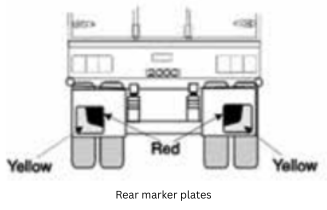
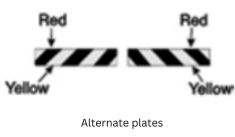
Accordingly, it is recommended that the following be fitted to agricultural trailers:
- rear marker plates of the type used on trucks be fitted to the rear
- flashing rotating lights be fitted to towing vehicles and reflective tape on all faces of the vehicle that can be seen by other road users.
Difficulties in seeing and recognising the vehicle and how it is being used is made harder by low contrast colours and environmental factors such as foliage, low levels of light, dust and smoke or poor weather conditions such as fog or rain.
Lighting
All lights and lenses should be kept clean and in good working order.
Daylight operation in clear visibility
An agricultural trailer being used in the hours of daylight when atmospheric conditions allow visibility of at least 250 metres should have fitted and operational:
- direction indicator lights on the rear of the trailer unless the indicator lights on the towing vehicle can be clearly seen by other road users;
- stop lights unless the stop lights on the towing vehicle can be clearly seen by other road users;
- a pair of white front reflectors;
- a pair of red rear reflectors; and yellow side reflectors.
The reflectors are a minimum requirement to ensure that the vehicle can be seen if it is parked at the side of the road in low light conditions or after dark.
Night operation or restricted visibility
An agricultural trailer being used at night, or when atmospheric conditions restrict visibility to less than 250 metres, should have fitted and operational:
- direction indicators light, stop lights, tail lights
- a pair of white front reflectors;
- side marker lights if exceeding 2.1 metres wide; and
- front position (side) lights if exceeding 2.1 metres wide;
- front position (side) lights if exceeding 1.8 metres wide and side marker lights are not fitted;
- front position (side) lights if exceeding 1.6 metres wide, exceeding 4.0 metres
- long and side marker lights are not fitted;
- yellow side reflectors;
- a pair of red rear reflectors;
- front and rear end outline marker
- front and rear outline maker (clearance) lights on agricultural trailers exceeding 2.1 metres wide.
Towing vehicles other than tractors
An agricultural trailer being towed by an agricultural machine or a conventional motor vehicle, should not exceed a posted speed limit or any lesser limit specified by:
- the trailer manufacturer, or
- the speed rating of the tyres; or the towing vehicle manufacturer.
Travel speed should also take into account potential instability of the combination due to:
- the construction and equipment of the trailer; or
- the construction and equipment of the machine.
The coupling used when an agricultural trailer is towed by a conventional motor vehicle should be either Australian Design Rule compliant or comply with the information in this bulletin.
For further information on specific couplings, consult the coupling manufacturer.