

Places to ride
Find out where it's legal for you to ride your bike.
Bikes are classified as vehicles meaning cyclist are permitted to travel on arterial roads and local roads.
There are some locations that bike riders can use which other road users can’t, like bike lanes and designated bike paths. They can ride on shared paths, alongside pedestrians.
View bicycle and walking route maps.
Bike lanes
A bike lane is an on-road marked bike lane designated for bike riders.
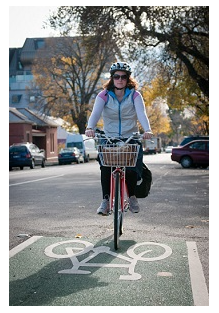
It'll have a 'bike lane' sign at the start of the lane and a 'bike lane ends' sign where it ends. They can also end where the lane comes to an intersection.
If you're riding on a road with a bike lane in the direction you're going you must use it unless it's not practical or safe to so.
Most bike lanes will have bike symbols painted on the road at regular intervals and some have arrows indicating travel direction.
You'll also see green sections in bike lanes. The green surface treatment is added to areas of high traffic volume or where a bike lane crosses a vehicle turning lane. You might also see it in bike boxes at intersections.
Bike paths
A bike path is a separate path designated specifically for cyclists. They're usually next to a road or completely off-road like the one on St Kilda Road in Melbourne. (They can also be called Copenhagen lanes.)
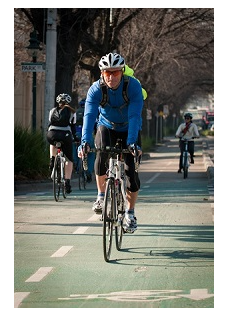
The path will be signed both at the start and end. It can also end where it meets the road or footpath.
Where the path is bi-directional, you're likely to see bike symbols painted on the road at regular intervals with an arrow showing travel direction and a centre line (either solid or dashed). Like a road, you need to ride on the left and you shouldn't cross the centre line unless you absolutely need to.
Only cyclists and pedestrians who are pushing a wheelchair, on rollerblades, roller skates or a similar wheeled recreational device can use a designated bike path.
Shared paths
Shared paths are paths designed to be used by pedestrians and cyclists and are usually completely off-road. Examples are the Capital City and Kororoit Creek Trails in Melbourne or the Lilydale to Warburton and High Country Rail Trails in rural Victoria.
A shared path is identified by the image of a pedestrian and a bike on the pavement or on a post.
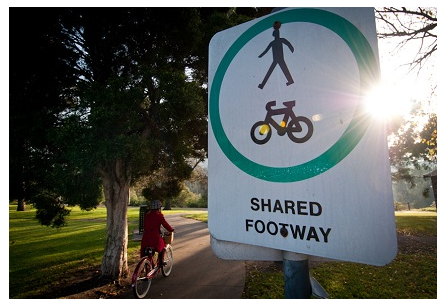
If you're riding on a shared path you must give way to all pedestrians. This include people using wheelchairs, mobility scooters and wheeled recreational devices. (Wheeled recreational devices include rollerblades, skates, skateboards and scooters.)
If you're using a shared path you must keep to the left unless it's not practical or safe to do so.
You'll also need a bell or similar warning device on your bike so you can let other path users know you're there and you want to pass them. Alternatively, you can clearly say "passing" or "on your right".
If riding when dark, you should wear bright, visible clothing and have front and rear lights on your bike, as some parks and paths aren't well lit.
Footpaths
The only cyclists who can legally ride on a footpath are:
- children under the age of 13
- adults or children 13 and above accompanying children under 13 years
- Australia Post workers
- those with a relevant medical certificate.
When riding on a footpath, you must keep to the left, give way to pedestrians and slow down if overtaking.
If riding on a footpath, watch out for drivers entering and exiting driveways who may not be able to see you approaching.
Freeways
Cycling isn't allowed on urban freeways. However, it's allowed on the shoulder of some parts of rural freeways.
Urban freeways
Cycling isn't permitted on the following urban freeways:
- Western Ring Road
- Metropolitan Ring Road
- Eastern Freeway
- Tullamarine Freeway
- Monash Freeway
- West Gate Freeway
- Mornington Peninsula Freeway
- Frankston Freeway
- South Gippsland Freeway
- Princes Freeway West (east of Werribee)
- Princes Freeway East (urban section)
- Calder Freeway (urban section)
- Western Freeway (urban section)
- Hume Freeway (urban section)
- Peninsula Link
- East Link
- City Link.
There are signs indicating ‘No Bicycles beyond this point on this freeway’ on the entry ramps along the urban freeways listed above.
Rural freeways
Cycling is permitted on the shoulder of some parts of the following rural freeways:
- Western Freeway
- Goulburn Valley Freeway
- Calder Freeway
- Hume Freeway
- Princes Highway West (west of Werribee)
- Princes Freeway East.
Why is cycling permitted on some freeways and not others?
Cycling is permitted on the shoulders of rural freeways because they're the most practical route for cyclists. They also have relatively low volumes of traffic on main roads and few entry and exit ramps cyclists need to cross.
Cycling isn't permitted on urban freeways because there are safer routes that bike riders can take. They also carry relatively high volumes of traffic and there are more entry and exit ramps, which often have more than one lane.
If you intend on riding on a freeway, check to see if there's a 'No bicycles beyond this point on this freeway’ signs on the entry ramp. If you see one of these signs, you can't ride on the freeway and need to find a different route.
Tips for cycling on rural freeways
- Ride as far to the left of the sealed road shoulder as you can.
- Travel in single file, except where there are wide sealed shoulders.
- Travel in the same direction as traffic.
- When crossing freeway entry or exit ramps, follow signs as directed.
- Cross freeway ramps at right angles. Don't cross diagonally.
- Use bicycle paths and alternative non-freeway routes where directed by signs.
Children are discouraged from riding on freeways, as they haven't developed the necessary road skills.